
Chapter Ten: The Undead

Mum was being especially chatty. It was mostly dithering rubbish. The sound of her and the afternoon carer’s laughter pushed up through the wooden slats of my old bedroom.
I was sat on the floor above, staring at eight-year-old me’s fluorescent finger prints on the bed box plush.
So many nights I’d woken up in here afraid to hear a creak in the hallway, a step near the door.
To my knowledge, The Man Who Is Not My Father never touched me again. He actually became a reliable adult, financially supporting me through college and picking me up in absolute silence from various gigs and outings.
I often tried to connect with him, lending him CDs and asking after his dad – an adorable WWII veteran who had taken an innocent shine to me as a fellow musician.
But the fear was always there. It hung like a dragged anchor through my teen years.
I grew up massively socially delayed. I had a couple of friends, one of whom was incredibly abusive, but I never went out. I never did things. I never made or maintained strong relationships.
The hours I’d spent in that bedroom reading books, fantasying, existing, wasting valuable days imagining I was in another world entirely. Curled up on a bean bag in a heavy, baggy jumper even as my breasts rebelliously budded at my chest.
Now, I could hear Mum’s laughter pushing up through the slats. For such a frail woman, she laughed like a much bigger person. It was the same laugh I’d hear every evening after school, while her and The Man Who Is Not My Father watched Fawlty Towers or Jonathan Creek or some cinematic murder mystery that made the floor boom.
I pulled myself away from the bright fingerprints, and set to fixing the wobble on the flatpack coat rack.
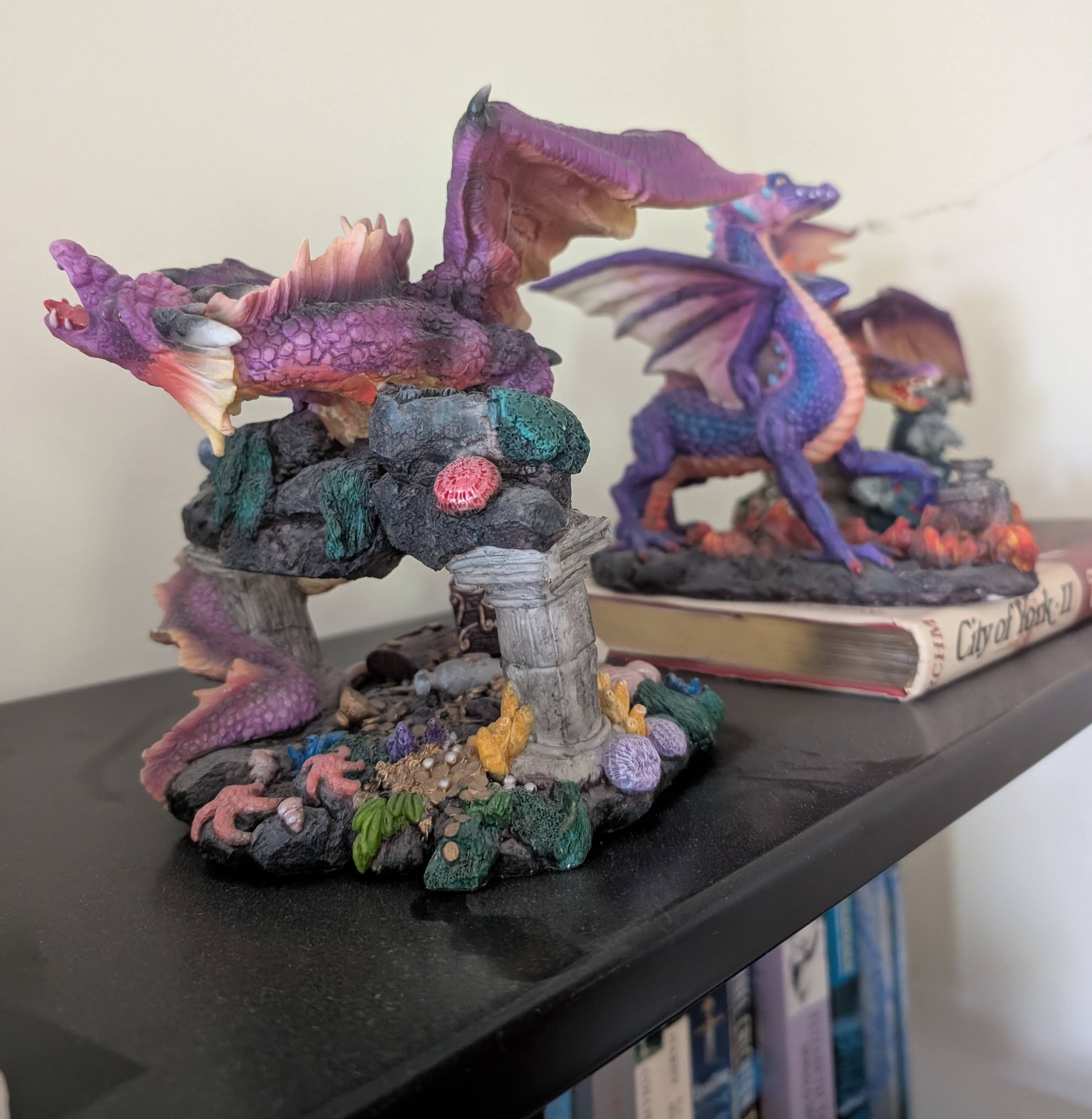
When I popped into the next room to dump the allen keys amongs all the other unsorted stuff, dusty dragons watched me from a top shelf. Gifts to me from mum when I was a teen, now pocked with dead spiders.
I wandered downstairs while the carers were finishing up. The younger one smiled at me.
‘Hiya. We’ve just had to burp the stoma bag, but everything’s in order.’
That was the first time I heard that phrase, and I hope the last. I’d already learned not to breathe through my nose while the carers were cleaning up.
‘Have you got my dinosaur?’ Mum asked.
I picked up the still-warm water bottle from under the bed as the carers wheeled it flush against the wall.
‘I’ll put him in for you,’ I said, lifting the covers and placing the plush animal against her feet. They looked a little blue.
‘I still think it’s a rhino,’ the older carer muttered.
‘Me and my daughter are having spaghetti bolognaise and garlic bread for dinner!’ Mum piped up suddenly, like an excited child.
‘Ooo, really?’ The younger carer fawned. She peeled her gloves off, dumping them into a bag of soiled cloths and shit-covered paper. ‘You’ve got me hungry now.’
I cranked open a window, and brazenly stuck my head out. Even if someone had warned me about the sights and smells of end stage rectal cancer, I wouldn’t have been prepared.
And why wasn’t I warned about it?
Why are we, as a society, so ashamed and secretive about dying?
It’s the one life event that every single one of us will do.
We should talk about dying.
‘Do you want to watch the TV?’
‘No. I can’t watch TV when I’m in a bed. It feels wrong.’
‘Do you want a crossword?’
‘Nah.’
‘Your crochet stuff?’
‘Nah not right now.’
‘I can move the bed over to the patio doors. Give you a change of scenery?’
‘Nah. Is the fan heater on?’
Lack of interest in hobbies is one of the creeping signs of end stage cancer.
I was in denial.
Now that mum enjoyed being around me for the first time in decades, I wanted to do something with her. Watch a film, try some knitting. Just…have a good gossip.
‘Now there’s someone coming to look after me,’ she said happily, ‘I can start living.’
But she didn’t…live. She sat in that bed and wittered to herself or slept. She was undead.
I could see she didn’t have long left. A couple of weeks, maybe.
But she really thought she had that predicted year left. She talked about planning family meals and organising family holidays. Any kind of pushback, and she’d get so upset tears pooled in her eyes.
And what was I going to do, tell her “this is the last chance you’ll get to watch TV. It’s your last chance to show me how to crochet. You’re going to be dead very soon.”
On top of that, PTSD made it exhausting to be around her.
Forgiving is one thing; forgetting is another. Every interaction brought up another buried memory.
The time shortly after the big incident when Mum told me “I’m not very happy with The Man Who Is Not Your Father at the moment” while we were browsing toys in Woolworths.
The way she looked at him with hawk eyes when he and nine-year-old-me talked.
That night she woke me to put me on the potty and I wasn’t wearing any pants because I’d – unbeknownst to her – kicked them off; how her eyes were wet with fear.
But no amount of forgetting was going to make me okay with the sight of my mother – or anyone – emaciated, skin hanging off, absent-mindedly picking at the sticker of her stoma bag.
She wanted to sit up. I got her in a bear hug and pulled her further up the mattress. Her bones poked into my full chest.
Her t-shirt rolled up. I saw bare, sagged breasts tapping against the stoma bag. The skin on the belly that had formed me and my brothers was crinkled like a crepe sheet. It pooled at her sides, empty and loose.
She smelled of stale milk and Charlie Red body spray, with an undertone of shit.
She used to smell of Estee Lauder Knowing, and Bacardi, and hair spray.
Christ, I would have given anything for her to smell like that again.
That evening, the hospice carers arrived while I was shoving frozen garlic bread into an air fryer, and trying to decipher the buttons on a microwave.
In my teens, there was no air fryer in here. No microwave. No toaster. There wasn’t even a kettle.
There was an Aga. That’s a hefty cast iron range cooker with a simmer plate, boiling plate and a series of oven boxes of different temperatures. Cooking anything in it was a juggling act between heavy square doors.
Mum was an expert. Every night she cooked dinner with her partner, switching trays and dishes between the compartments with sturdy efficiency.
If I wanted some toast, I’d have to put bread between two hatched plates of this sort of…grippy thing. And I’d often end up burning it – that is, unless mum heard me mucking about and bundled in to finish whatever I was making for me.
‘Give it ‘ere,’ she’d say, shoving me away with an elbow.
Back then, she refused to get any appliance that could do a job that the Aga could. Because the Aga was on all the time as part of its heat-retaining design, using a kettle would be “wasting” the heat the big metal oven was putting out anyway. And for her, saving a couple of quid a year was a huge thing.
A couple of years ago, mum and her partner rinsed thousands on a beautiful raspberry-coloured replacement with gas hob Aga. It looked as clean as the day it was bought.
The Man Who Is Not My Father had a stroke shortly after. He was in hospital for months. When he came back home mum became his full-time carer, and fresh homemade meals turned into pre-packaged microwavables.
For obvious reasons, I didn’t talk to mum much about The Man Who Is Not My Father. But sometimes in passing, she’d talk about life with him the past few years.
‘He got so angry, after the stroke’ she said, eyes pooling with tears, ‘he’d want to go down to the shops in the middle of the night, and get violent when I tried to stop him.’
Considering her first husband beat her up, that was hard to hear.
Upstairs in the bedroom and ensuite, I found clues of mum’s misery.
Three or four years of rectal cancer produced a lot of products for her avoidant symptom management.
In the bedroom drawers were packages of enormous period pads, upgrading to parachute-like incontinence pads, up to “discrete” incontinence pants with cute flower prints and elastic trim.
It amused me how the hips on the packaging belied a model clearly in her twenties, turned coquettishly with manicured hand on the curve of her pale waist. Can women not even piss themselves without being sexualised and expected to stay youthful?
In the ensuite bathroom I found various treatments for hemorrhoids. No painkillers though – only joint rub and some a battery-powered pain patch, unopened.
By the time mum was in hospital, the cancerous tumour in her back passage was so enormous it was poking out. The pain must have been unbearable.
She’d been looking after a man whose brain is scrambled eggs, she’d been in agony, she’d lost control of her bowels and she’d been in denial: and not once had she confided in her three children or her sister.
I brought the carers a bowl of warm water and a flannel. I noticed mum couldn’t lift herself at all now, she needed rolling and moving entirely by the apron-clad ladies.
‘Do you want to change your shirt, Kay?’ said the red-haired lady from earlier, while the ethereally pretty carer took the bowl from me.
Kay isn’t her name. Her and my aunt T use their middle names as their first names. But mum’s middle name is Karen – and she hates the way it’s pronounced, always insisting it’s actually care-ren.
So to make things easier, she introduced herself as Kay. Why she couldn’t just use her first name, I’ve no idea. She likes to overcomplicate things. It makes her feel special.
With the bed sitting her up, mum seemed alert. She picked at the low rim of her t-shirt, where the stoma patch leaked onto the fabric. I fumbled through a little pile of clean shirts and propped one on the bedside table.
‘Me and my daughter are having bolognaise and garlic bread,’ mum said with a smug grin. The older carer was helping to pull mum’s shirt off, and I glanced away so I wouldn’t see a deflated breast again.
‘I can smell that garlic bread,’ the younger carer said, ‘It smells lovely, Kay.’
‘And then,’ mum continued, ‘we’re having ice cream with Bailey’s on, aren’t we, kid?’
I smiled grimly as the ladies cooed. To be called an affectionate nickname by a woman I barely knew made my muscles tense.
How odd is it that we will never be as intimate with anyone as we are with our own biological mothers. We were inside their uterus. We were created by them, they were our god making us from clay. Without consent. We are raped with life.
I was thinking a little too darkly, and I knew it. I took the used water bowl back into the kitchen, and returned to the bed being pushed back against the wall and mum being propped between cushions.
‘That’s everything then, Kay,’ the older carer said, ‘We’ll see you when we see you. Alright?’
Mum shuddered a little. Then;
She slumped back against the mattress, an odd smile on her face. Her eyes closed.
‘Whurmmur…’ She murmured, like she was drunk.
The carers and I shared a look.
‘Kay?’ The older carer with the bright pixie cut said, ‘Kay, are you still with us?’
Mum didn’t respond. Her chin fell on to her chest, and she slumped up against the wall.
Oh shit.
‘What’s happening?’ I asked, well aware my voice was wobbling.
‘Kay? Kay, are you still with us?’
Mum, eyes closed, nodded. She looked like the drunk middle-aged woman I’d helped home in Leeds, who lolled her head back against the harsh stone of a pub wall.
For a few minutes the three of us tried to rouse my dying mother. Her skin was clammy, cold.
Oddly, I felt tears pricking at my eyes.
‘We’ve got a nurse in the car,’ the older carer said to me. ‘I’ll go get her.’
Shortly after, a bright-looking young woman entered, holding a small green canvas bag which she flipped open on the table.
‘What’s happened?’ She asked me.
‘I don’t know,’ I looked at the carers for backup. ‘She was fine, and then she just sort of…collapsed?’
‘What’s her name?’
‘Kare- er, Kay.’
‘Kay? I’m a nurse. I just want to do a couple of checks on you, is that okay?’
Mum didn’t respond, but an odd smile danced on her crinkled face. Her eyes rolled frantically under thin lis.
‘I’m going to put a stethoscope on you, might be a bit cold.’
The nurse placed the metal disk against mums bony chest.
Then she reached back into her bag, brought out a small torch. She lifted mum’s eyelids, and shone it into each eye. There was only white. She looked possessed.
When the nurse withdrew, mum’s eyelids shut like reels on a slot machine. The nurse looked at me and the carers with some confusion.
The four of us spent the next minute or so gently shaking mum’s frail body, calling her name.
Suddenly, she stirred. Her eyes opened slowly.
‘I won’t knock anything till I’ve tried it,’ she said, loudly. ‘Apart from lesbianism.’
I just about died myself.
‘Oh my GOD, mum,’
‘Well I’ve not had a go.’
Hands on my head, I paced away from the bedside.
‘Oh, right then,’ the nurse laughed. ‘Bit too much information there.’
Relief filled the room.
‘You gave us a bit of a scare there, Kay,’
I realised I was crying.
The worst part wasn’t knowing it was going to happen. The worst part was not knowing when it would.
And not knowing how the fuck I’m supposed to feel about it.
With the carers gone and the house calm, I divided the microwave bolognaise into two bowls and propped them and a plate of garlic bread, spread with cheese, on her bedside table.
‘Pull that over here,’ She said, pointing at the footstool. ‘You can sit on that.’
Although I put her bowl on her lap, she kept pushing it down beside her legs and then jabbed her own knees with the fork. She got pissy with me when I moved the bowl back up.
‘I know what I’m doing!’ She snapped.
She had no idea what she was doing.
She managed to hold and eat the garlic bread fine. Eating quietly, I watched her. She was content, happy to be doing a family activity after such a long time.
But I was perched on a footstool and she was dying in a bed. A bed which made popping and shushing sounds as the mattress rearranged itself under her gentle weight.
It wasn’t exactly a stick-it-in-the-family-album moment.
She started retching.
I panicked, and picked up the little bin beside her bed. She propped herself against the wall, holding it in one bony hand.
She heaved loudly into the bucket.
‘Give me the bread,’ she snapped, arm reaching for the plate.
‘Er, but you’re throwing up?’
‘I know, but just give me it. I know what I’m doing.’
I handed her the plate. She started eating the garlic bread, intermittently retching into the bucket.
‘Are you okay?’ I asked, confused.
‘This is gorgeous. This cheese spread is lovely.’
And she retched into the bucket again.
I wasn’t sure what to do, so I sat there and ate my spaghetti bolognaise.
She wasn’t actually being sick. The cancer was making her body rebel, controlling her muscles. Like how rabies makes a thirsty man’s body reject water.
And she ate all of the garlic bread, enjoying every bite in-between the retches. She was so happy. She was having dinner with her daughter, and at that moment it was the thing she wanted more than anything else.
We chatted in between her dramatic heaves. About food, her favourite alcoholic drinks, about the kind of shenanigans her and my aunt got up to on nights out in their youth.
‘I remember,’ she said after I’d lamented about my poor financial situation, ‘Having to choose between buying new tights and food for my son. I used to put sugar between slices of bread.’
That humbled me. I shut up about my overdraft.
Every time she talked about that part of her life, when she was a teen married to a man pushing forty, a darkness passed over her face. When she’d ran away, taking J with her, she lived in a shitty bedsit and regularly went without so her son could eat.
Before mum stopped contact with me, she never talked about that dark part of her life – although I knew it had happened. She’d mentioned maybe once or twice that J’s dad had beaten her.
But I’d never known till now she was barely seventeen when he started noncing her, or that he regularly had multiple other girls, or that he was deeply jealous and controlling and wouldn’t let her out of the house.
I’d never known that her best friend at the time rescued her, helping her pack while her husband was at work, and smuggling her and toddler J to a bedsit. She’d absolutely nothing when she left, and she was too embarrassed to tell her parents the state she was in.
She must have been so broken. And she was barely twenty-one years old.
It’s true, I suppose. Hurt people hurt people. That must have been when her spiral began, the butterfly flapped its wings and years later she would choose another man over her children.
(That being said, I sincerely hope mum’s first husband suffered an unimaginably painful, long-drawn-out death. I expect J, who does remember seeing that waste of life beating mum up, feels the same.)
Mum cheered up when I brought her ice cream with knock-off Baileys poured over it, and made ridiculous noises of joy at the taste.
‘You know what? For the first time in a long time, I’m feeling really happy.’
When I leant over to move her pillow, I knocked her glass of water.
‘Oi! Did you just put something in that?’
‘No, I’m not drugging you. If I was going to kill you, I’d just strangle you.’
‘That’s not the best way to kill anyone anyway.’
‘Oh, aye? You’d know, would you?’
‘I’d put powdered glass in a drink.’
This caught me off guard. Was this an especially mafia part of the cancer talking?
‘Who told you that?’
‘Oh…someone,’ she smiled wryly. ‘Someone who was a bit of a criminal.’
‘Are you talking about Jack?’
‘Aye. Jack the lad.’
Oh, good. So my supposed biological father was “a bit of a criminal”. Maybe it would be best to hold off on the 24 And Me, just in case my kneecaps suddenly become an endangered species.
‘And he’d done it before, too,’ she added.
Oh, it gets better.
It’s an urban legend, by the way. Don’t feed your annoying coworker glass-laced coffee. Just stab them instead.
Mum woke me at 1am, shouting that she ‘wasn’t right’. She refused to take a lorazepam, no matter how much I explained it would help her get comfy. I was exhausted, and she was argumentative.
‘I’ll call the district nurse…’
‘No!’
‘Mum, you’re in pain.’
‘I don’t want anybody coming over!’
For the next couple of hours I was dragged from sleep by the calling of my name, my deadname, or Amazon’s assistant. A few times mum screamed for York Mix Radio to come on, and turned it up to ear-splitting levels.
‘Alexa! Volume up! Why isn’t it turning up?’ She demanded when I bumbled in for the nth time. It was so loud I felt like I was in a bar full of Micheal Buble’s.
‘Mum, I’m calling the district nurse. ALEXA, shut the fuck up.’
‘I don’t want the nurse!’
‘Mum, please, I need to sleep and you need painkiller.’
‘I don’t trust painkillers!’
‘You’ve got to mum, please.’
‘Fine!’ She spat. ‘If YOU think it’s what YOU want to do!’
At the point it didn’t matter whether the bitch in her was her actual personality, the cancer or the pain talking – I wasn’t going to argue. About forty minutes later the district nurse called me to let me know she was on her way.
While I waited, dipping in and out of sleep and handing mum water when she asked, I had a horrifying thought.
I could kill her.
I could kill her, right now. I could suffocate her with a pillow.
Who would know? She’s dying. It could look like she’d gone in her sleep.
It would be a mercy.
It would be retribution for the life she took from me.
The life without the PTSD, without the flashbacks, without the constant second-guessing of my own self-worth after my own mother chose a man over me.
She’d be at peace. I’d be at peace. Neither of us undead any longer.
That feeling up my arms again, from my base. That burn of being about to do something horrible. The cold chill of feeling capable of it.
A rap at the door.
I let the district nurse in. Bold rays of sunlight peeked through the curtains as she leant over the bedside, speaking softly.
‘Do you want a pain injection?’
‘Whatever, just do it please.’
After, the nurse joined me in the kitchen. I’d given up on sleep and flicked the kettle on.
‘She’s obviously in a lot of pain. I’ll get a stronger pain patch prescribed today, but you’ll have to check it stays on. The last one had fallen off. Have it put on her back where she can’t pick at it.’
I nodded blearily. She gave me a sympathetic look, filled in her notes, and left me to my thoughts.
My heart felt like it was inside that undead woman’s shell, beating for her.
Why can’t I just let her go?
thank you for reading x